July- not just all about the water
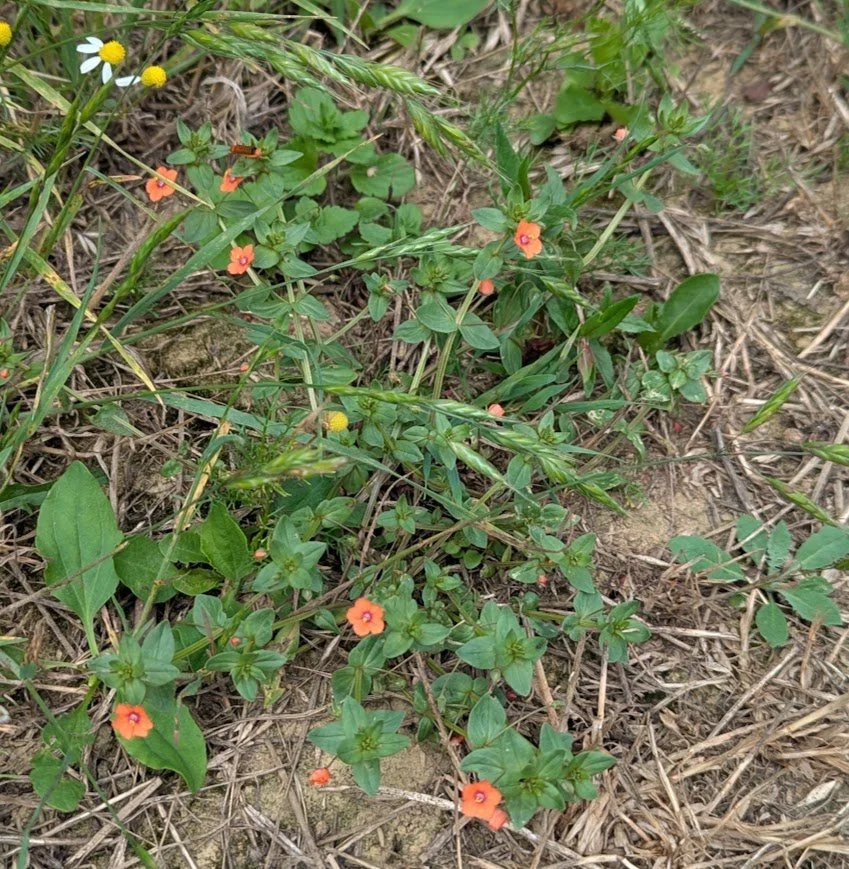
Scarlet Pimpernel- small but mighty
Open in sun, closed in rain
I’m the poor man’s weather vane
(Traditional)
Scarlet Pimpernel is out now, dotting the edges of the fields with it’s startlingly bright red flowers. Despite being tiny it really catches my eye. Apart from field poppies, that orange red colour doesn’t really appear much native flowers- which are on the pinky purple side of red.
True to its reputation, the Scarlet Pimpernel has been firmly open through this month, correctly predicting the rain that just didn’t come. The garden is wilted, and trying to keep everything alive has become, well, quite trying.
Luckily, Southeast Water decided it was a great time to implement a hosepipe ban, presumably so they can conserve the water needed to supply the many gushing leaks that they haven’t repaired. Wouldn’t want them to dry up.
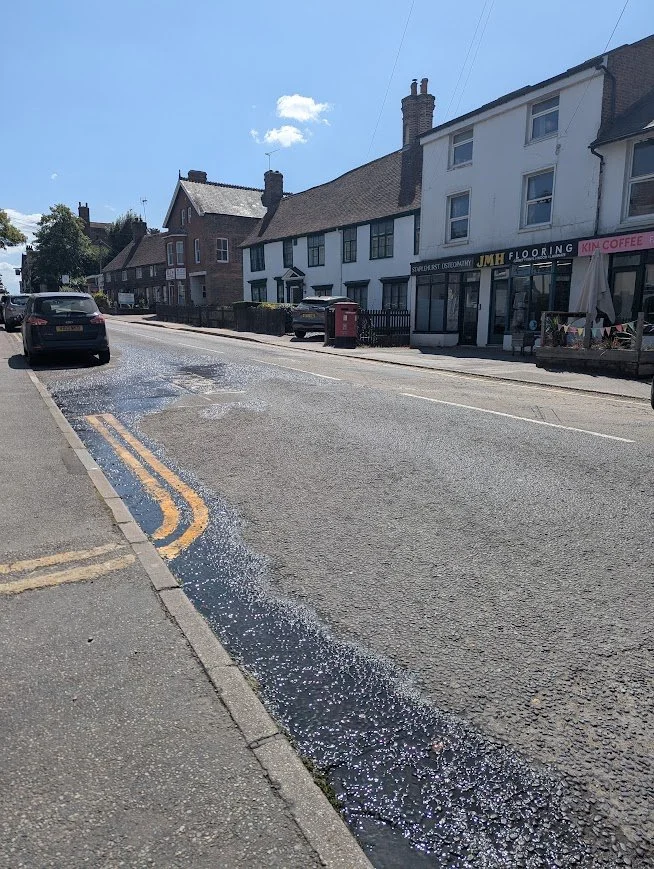
Is it a stream? No, it’s a burst water pipe.
Small Print and empty butts
It is my habit of many years, honed by countless hours spent looking for loopholes in the various NHS dictats bombarding general practice, to always check the small print.
Careful combing through those triumphs of bureaucracy over common sense usually revealed inaccuracies and self contradictions which often resulted in us being able to do pretty much what we wanted with complete impunity. I loved it- in General Practice you have to relish these small victories over the powers that be when you can get them.
I did the same with the southeast water website. Food plants are exempt from the hosepipe ban as long as watering by can is impractical. Which it is as the closest plots of my vegetable garden are still 50ft away from a tap, and some food plants are 200ft away.
Newly planted hedging and young trees are similarly exempt if impractical to water by can. Water supply intended for livestock can go by hose too. Actually, If I wasn’t interested in conserving water for the sake of doing my bit for the planet, it turns out I could hose down most of my garden!
As it is, I still much prefer a watering can so I can get a feel for how much water is going on. How much water depends on a couple of obvious things like size of the plant, what it’s evolved to cope with, and where it is in the garden. So for the veggies and fruit I use the hose to refill my water butts and dipping bins. I’ve been emptying the stinky duck pond water, and our only slightly less stinky bathwater by the can full onto the the most needy of my other plants.
To each according to his need
For well established plants the expert advice is to water only if they need it and then deeply, and infrequently as they have established roots, and having to dive deep for water with a bit of drying out closer to the surface actively encourages deep rooting and improves their future water resilience. Frequent shallow splashing on has been proven to do the opposite, encouraging plants to develop a poor, shallow, and vulnerable root system.
Please don’t do this for plants that you’ve only just put in though, either into planters or the garden border. It’s important to remember their roots are still only the size of the pot they came out of for a few weeks, and at the start they’ll dry out as quickly as they did in the pot before you planted them.
Saturating is wasteful for these newly planted babies, that excess water just drains down and away beyond the reach of their tiny roots, which are still only just starting to venture out into the soil, and it won’t increase the time interval before you have to water again.
They’ll do better with frequent light watering of the root ball and the soil just around it as soon as you notice they are a little droopy. This month my newly planted squash and cucumber plants needed a splash twice a day.
As the roots grow away and start to make mycorrhizal connections you’ll see they won’t droop so quickly, even when the area around the plant looks dry. Then you can reduce frequency and increase quantity when watering.
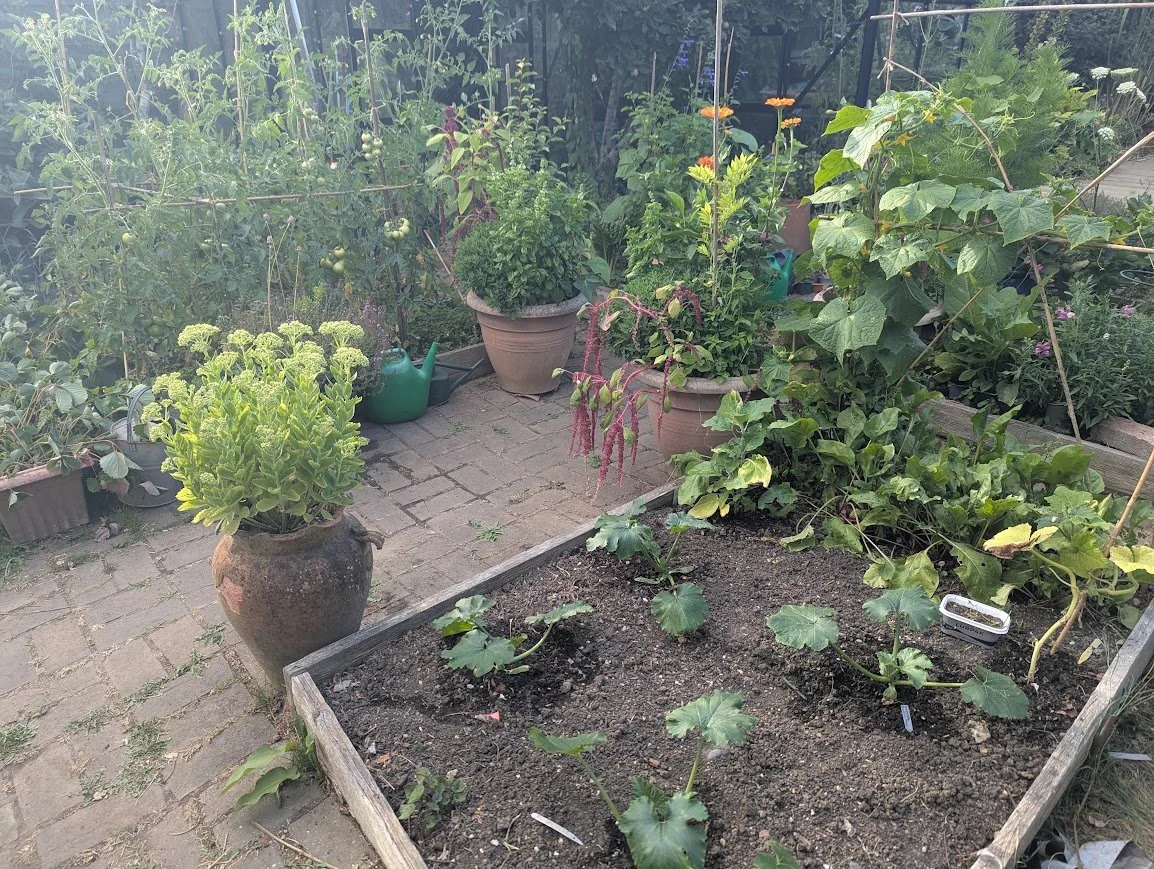
Squash plants like these courgettes need frequent watering initially
Drought proofing containers
Container watering can feel like a Sisyphean task on a par with painting the Forth Bridge. I’m not a huge fan, but every year I end up with more containers than I intended.
One option for a container that you don’t need to water so much is to plant cacti and succulents, and I do have a fair few of these. But woman cannot garden by succulents alone, so some adaption to reduce the watering is needed to achieve a balance: Some lush plant beauty but with reduced risk of irrigation-related insanity or heatstroke.
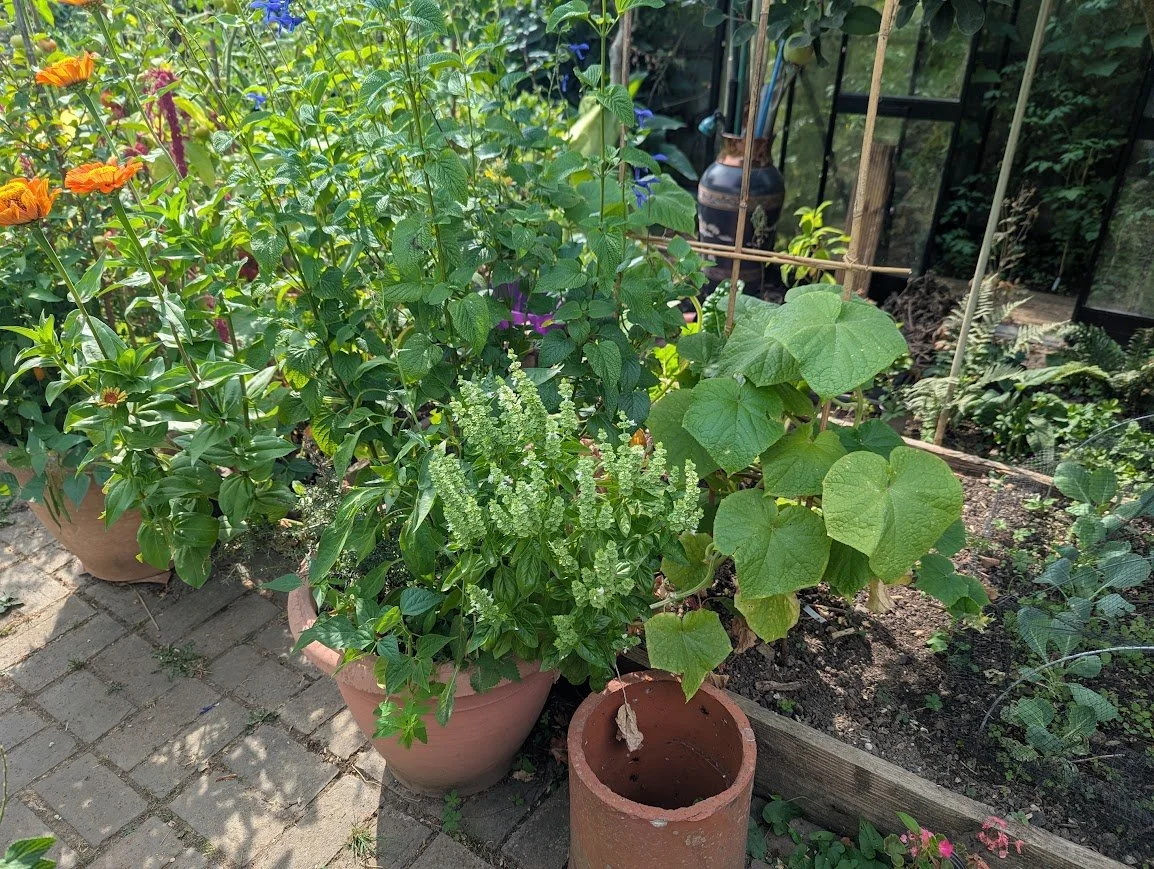
This pot has a cucumber, chilli pepper, zinnia, salvia, basil (flowering at the front),a small Manuka plant, and some dwarf french beans. It gets a can full of water once a day.
I like to line the bottom of containers with old compost bags. I want these more or less watertight so water will pool in the bottom quarter of the container. If I get a new container that hasn’t got drainage holes yet I’ll drill them in to the sides, again leaving a space below for water to collect.
Into that space I’ll pack some old twigs, or chunks of wood in larger containers, other options are old cotton clothing, sheep’s wool packaging, stacks of newspapers, old paperbacks that can’t be donated, or were so awful you don't want to subject anyone else to the purgatory of reading them, anything that will absorb water and retain its structure.
Then I pack the gaps with handfuls of weeds or half rotted compost. Then I top up with finished compost and plant up. The weeds stop the compost washing down into my water sump but still wick the water up to it, and also gradually decompose adding nutrients. Water pools in the bottom of the container and a goodly amount is reabsorbed rather than draining away and going to waste. It’s also very unlikely ants will find this desirable real estate to move into, so win win!
And talking of..
The ants are back, Ted
We love Father Ted. In our house we never need an excuse to watch a few episodes, and we are always quoting it. So this was a brilliant opportunity to slip a quick Father Dougalism in.
Every year at around this time the ant nest outside our back door erupts into action as scores of princes and princesses are helped by the workers to struggle up the nearest vertical structure (the wall, the plant pot and the rosemary in this case) whilst trying to keep their pristine delicate wings intact so they can launch recklessly and beautifully skywards for their one off nuptial flight.
They carry the hopes and the DNA of the colony with them and coordinated efforts of surrounding colonies will improve their chance to meet a partner from a different colony.
So the reason for Ant Flight Day isn’t just to be as annoying to us as possible. Turns out incest isn’t popular even in the insect world, though they aren’t bothered by the morals, but then neither were we (primates) in the early days of our species.
The dislike of incest is all about losing genetic diversity, losing vigour, and turning out odd looking kids with weird genetic disorders like Tutankhamun or the 16th century European royal families.
Anyway, back to the ants. When the princesses (or virgin queens as they are also known) find a prince they mate. He dies shortly after, DNA transferred, job done. She sheds her wings and buries into a likely looking bit of soil to start her own new colony. She digs the first brood chambers and corridors herself, lays her eggs and cares for her first daughters. Once they emerge they start to look after her, and if she’s lucky she’ll be the mother of thousands more.
I have several impressive ant hills in what used to be the lawn. It’s amazing to me to think all that soil was carried up an ant-load at a time whilst the ants developed a complex of corridors, store rooms, brood chambers and fungus gardens, eventually forming a huge subterranean citadel 2ft deep and up to 10 ft wide. That’s some serious help they’re giving me with my compacted soil.
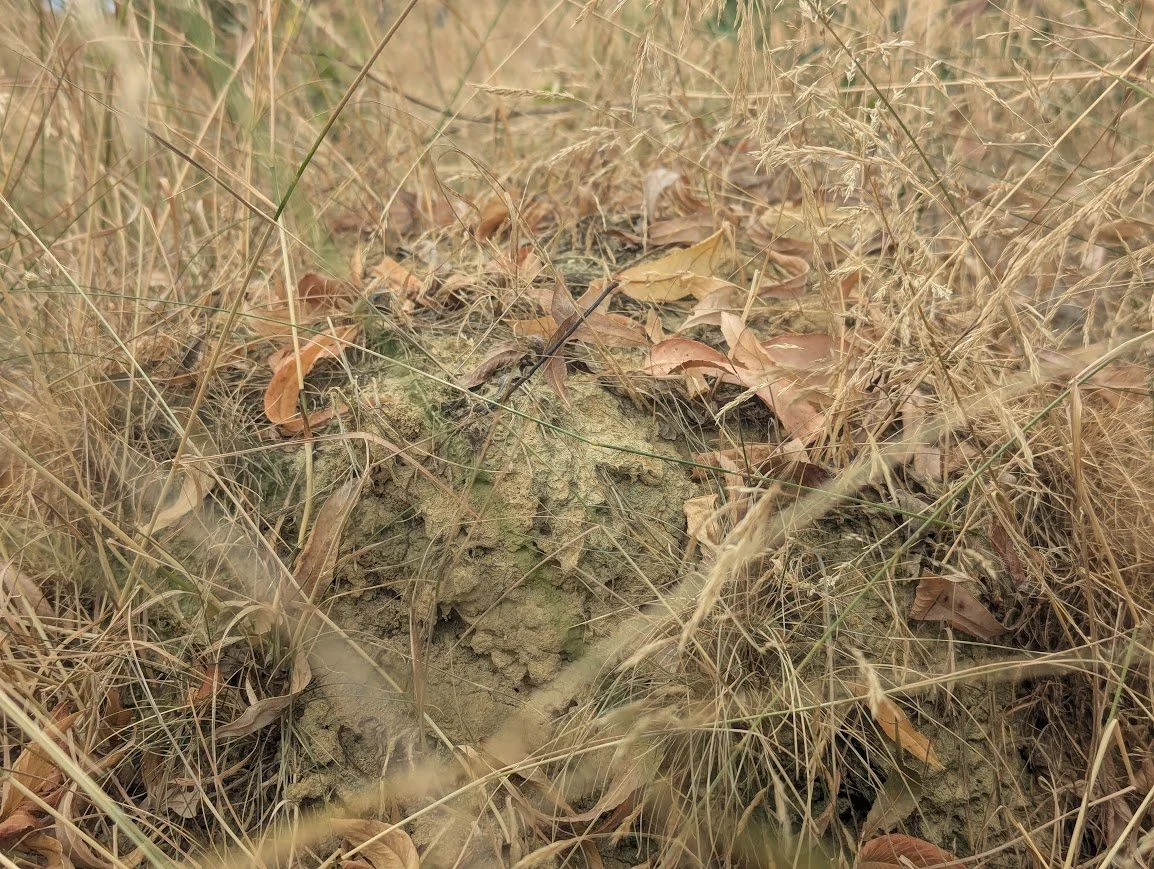
It may look like a huge dry cow pat but this is the ant equivalent of Milton Keynes
I like to think of the ants as the flightless sisters of the Aculeate Hymenoptera, mainly because that's what they are. Apart from their nuptial flight they are earthbound, unlike their siblings the bees and wasps.
The similarities of this wonderful and important insect family are clear to see though. They all have those beautiful nipped in ‘wasp’ waists, and many of them live in large complex, highly social, matriarchal and predominantly female colonies. The blokes are used for breeding and not allowed to get in the way of the day to day running of things. What’s not to love about that?
Lots of new babies
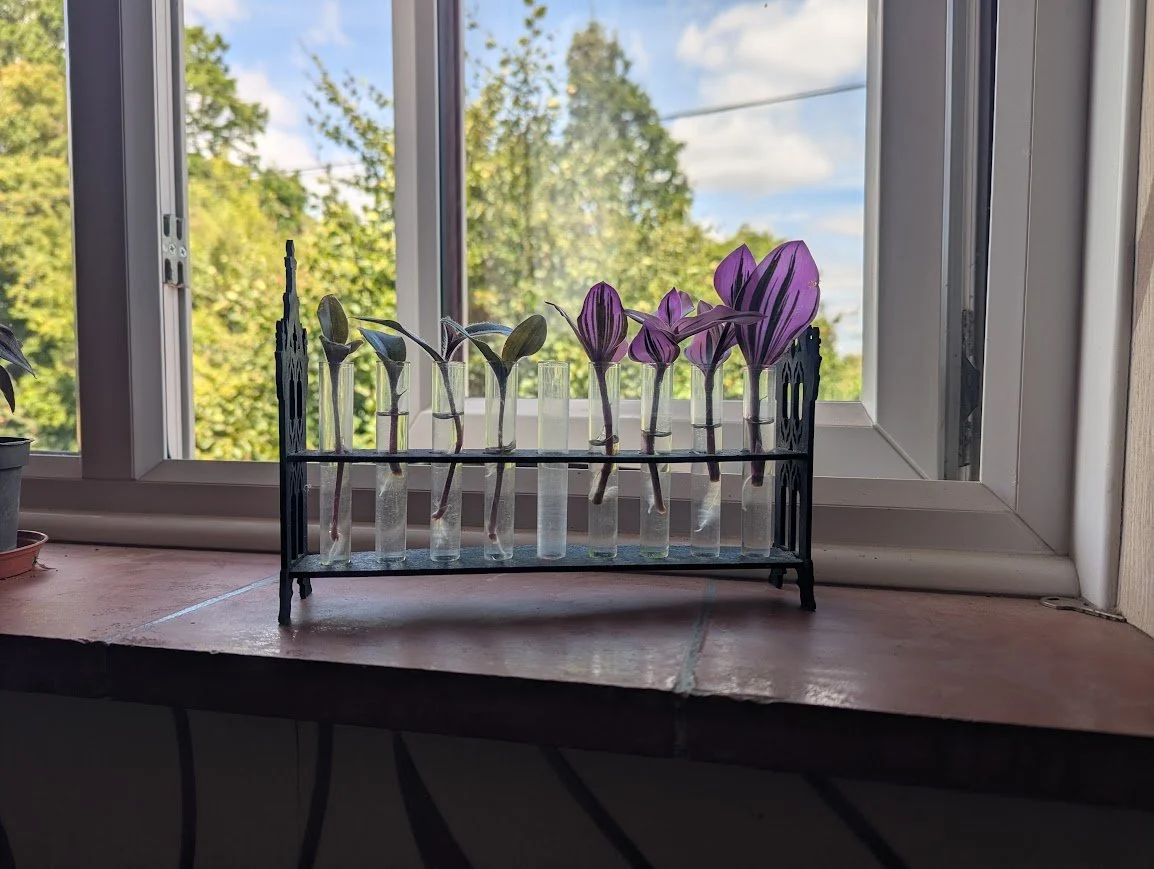
Tradescantia cuttings rooted in 8 days
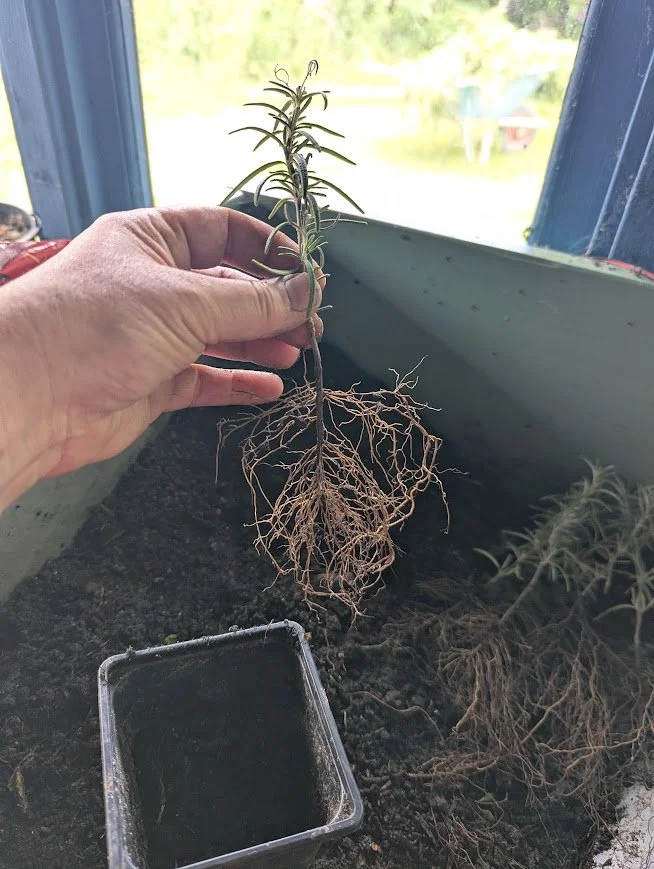
Rosemary cuttings root quickly and well
Despite the heat, July has been a good month for propagating, cuttings from lots of different plants do well in mid summer, tired leggy tradescantias are easy to rejuvenate, and scented leaf geraniums and rosemary are quick to root.
The seedlings for my mini wildflower / pollinator / herbal prairie are doing well. Rudbeckia Goldsturm, a mix of Michaelmas Daisies, Purple Loosetrife, Bergamot, Yarrow, Common Knapweed, Marshmallow, and Echinacea purpurea have all done really well from seed sown in May.
That sounds way more intentional than it was- I forgot to sow them earlier, then they waited ages to be picked out. It's a true testimony to their hardiness that so many survived. They’re now waiting in pots to planted once we get some rain.
I’ve also had a couple of nice surprises:
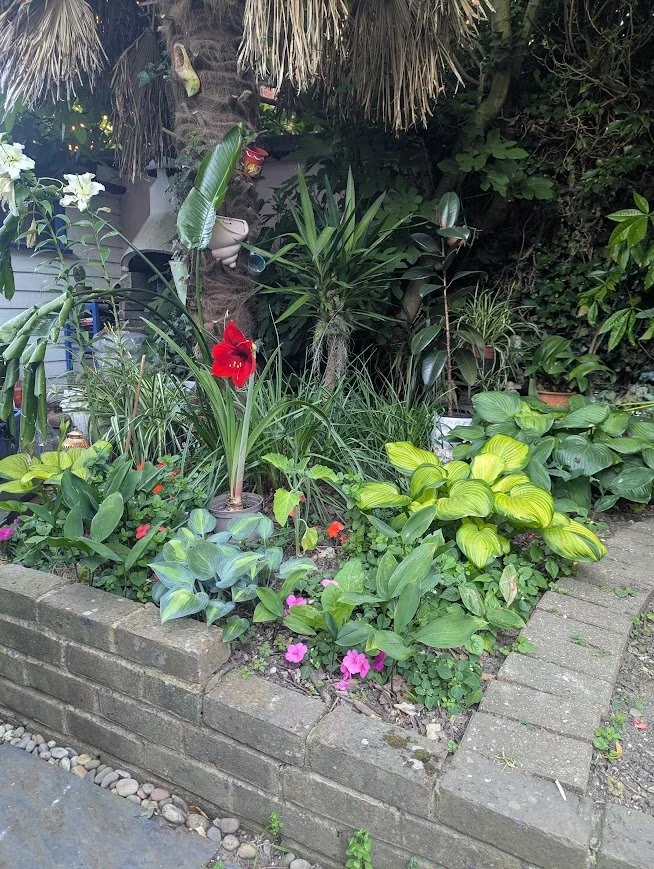
One of my amaryrilis plants flowered!
The heat and shock of being re-potted kicked some life into one of my amaryllis plants, I don’t think I’ve had a flower out of them for about 3 years. I also got a scattering of some gorgeous dark pink annual poppies (Papaver somniferum) in amongst the usual washed out looking lilac ones.
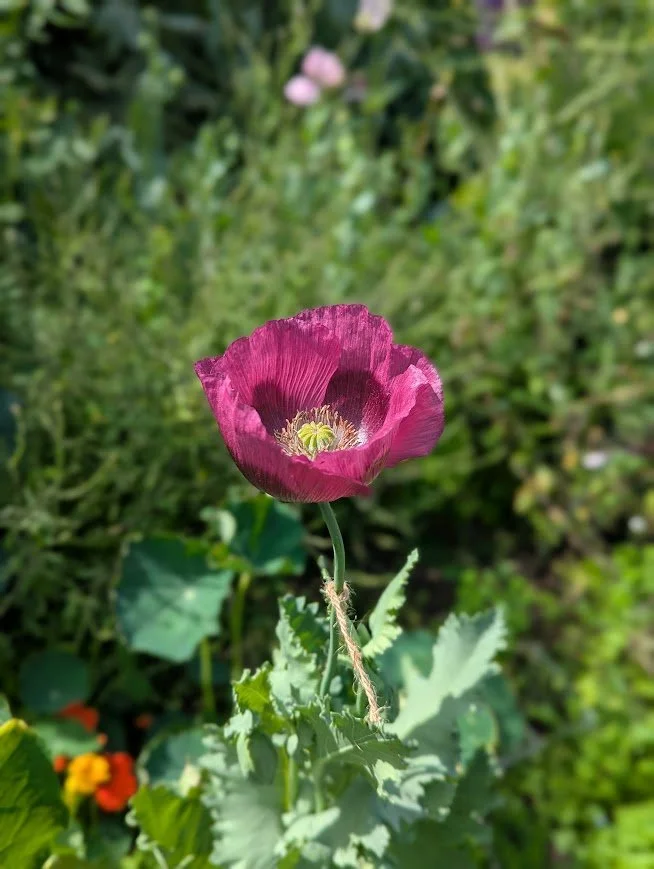
Make sure to tie some string round the really nice coloured annual poppies so you can collect the seed from the right ones later
Charlie’s July- A story in pictures

Snooze that heatwave away
July 2nd marked the 2 years anniversary of when we adopted Charlie. We didn’t celebrate it per se because we reckoned that for Charlie, if not for us, it’s been a two year long celebration of food, walks, chewing, and of course barking. For a dog of 10 years old, it’s been probably the best retirement ever.
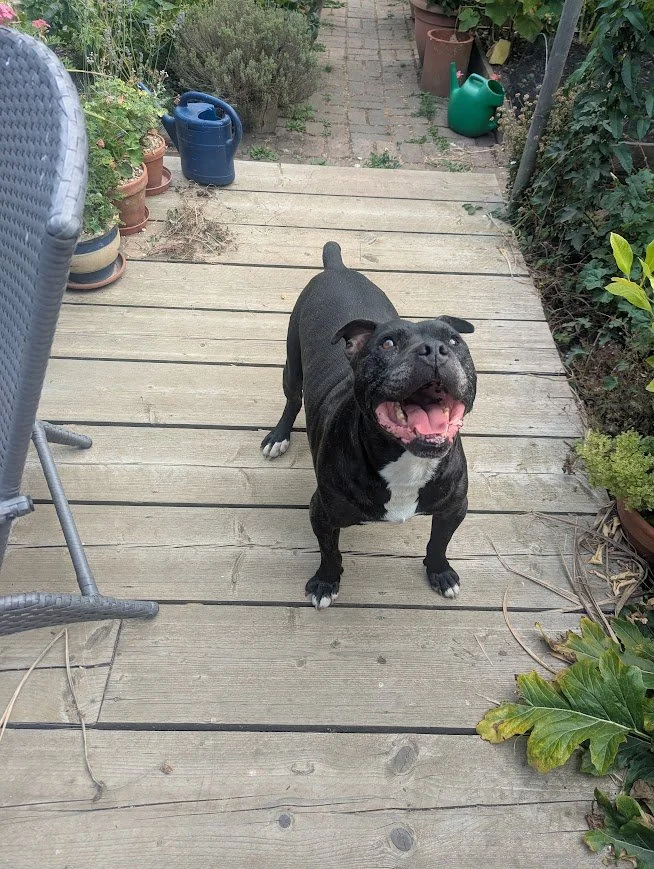
He got a big face!
For Charlie keeping cool this month has been mainly about the sleeping, with early morning forays out for a sniffari and a snack. He has however, even on the hottest days, insisted on a lunchtime potter down and along the ends of the neighbours’ gardens for a quick bark at anyone cheeky enough to be out in their own garden.
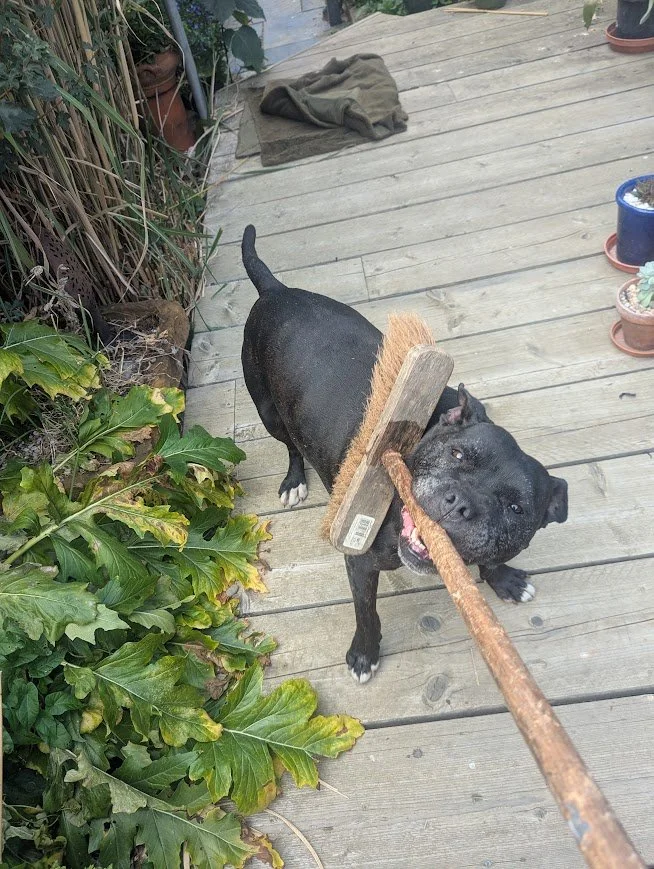
Just testing how serious I am about sweeping up the deck
The desiccated grass of the lawn is satisfyingly scratchy for a good roll on the way back from a snoop and a bark, and of course he helps himself to any container with water in it.
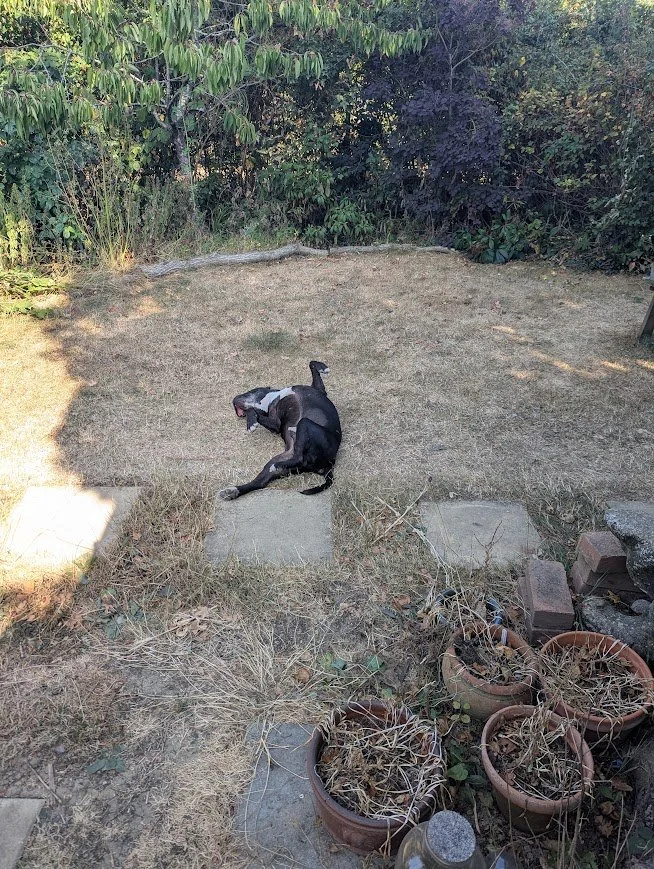
Loving the dried grass. Just as well he ensures to shake off all the bits and doesn’t bring them into the house
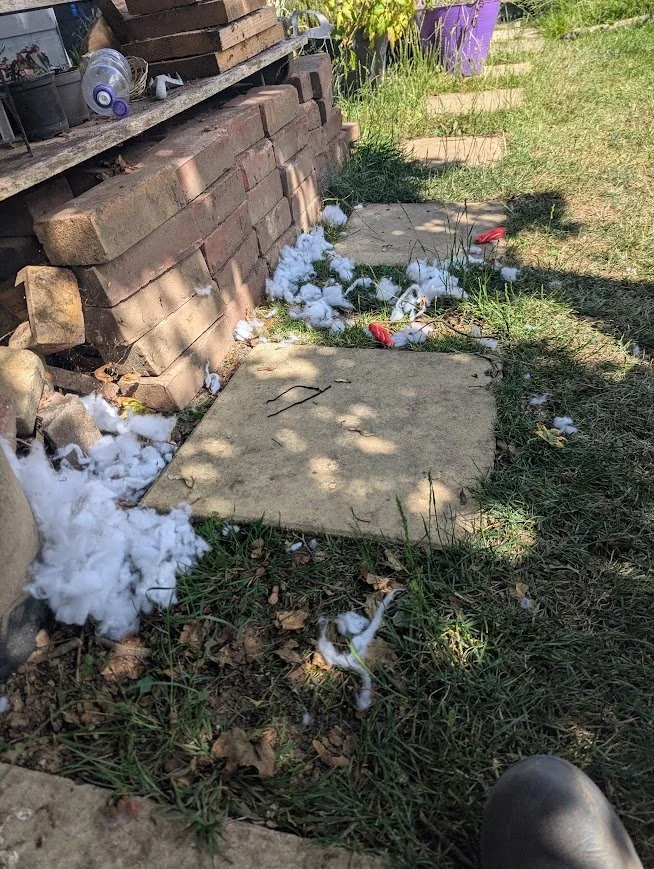
Somebody call the soft toy disembowelment clean up brigade..
We just have to bring him in when Bertie (next door’s dachshund) is out in the garden. One bark from Bertie and Charlie will happily give himself heatstroke running up and down the fence in a mad barking frenzy.
Apart from that, just a few odd minor incidents that have been nothing to do with him..
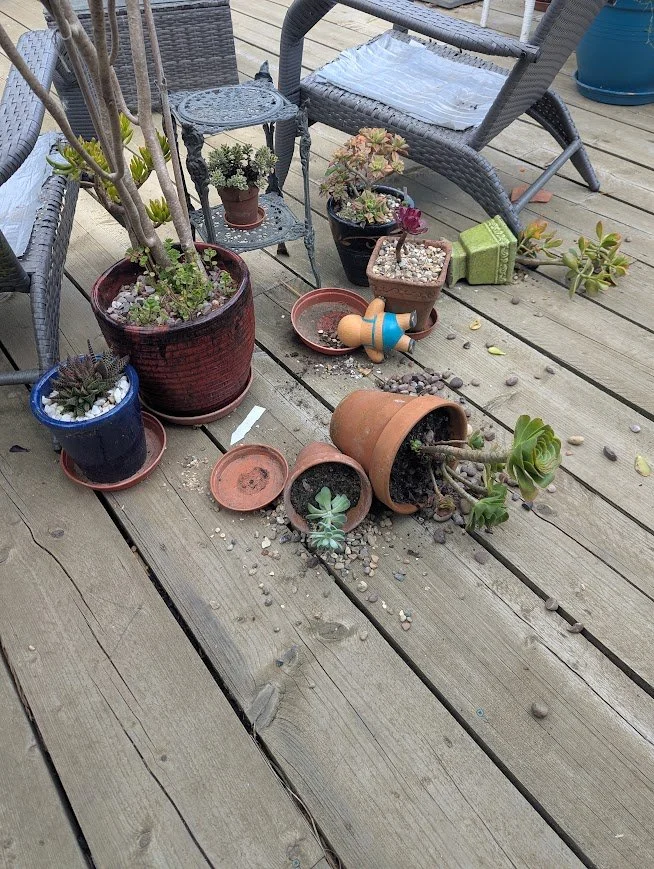
Transvestite Sloth squeaky toy attacked my pots of succulents. Charlie was nowhere near them at the time
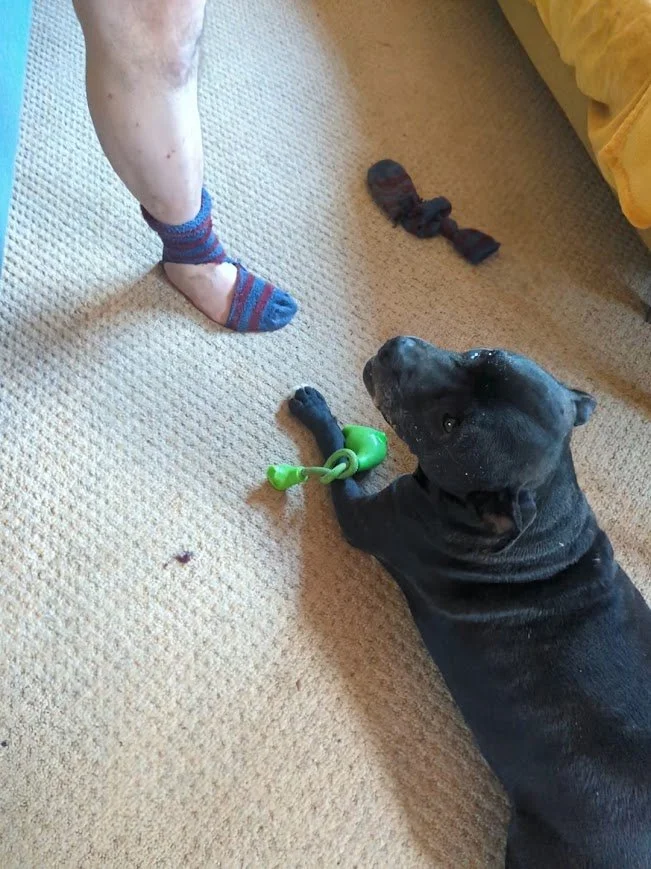
No, I don’t think you could give that away as a prize. Stu’s sock unaccountably dissolved. Charlie was nowhere near it at the time.
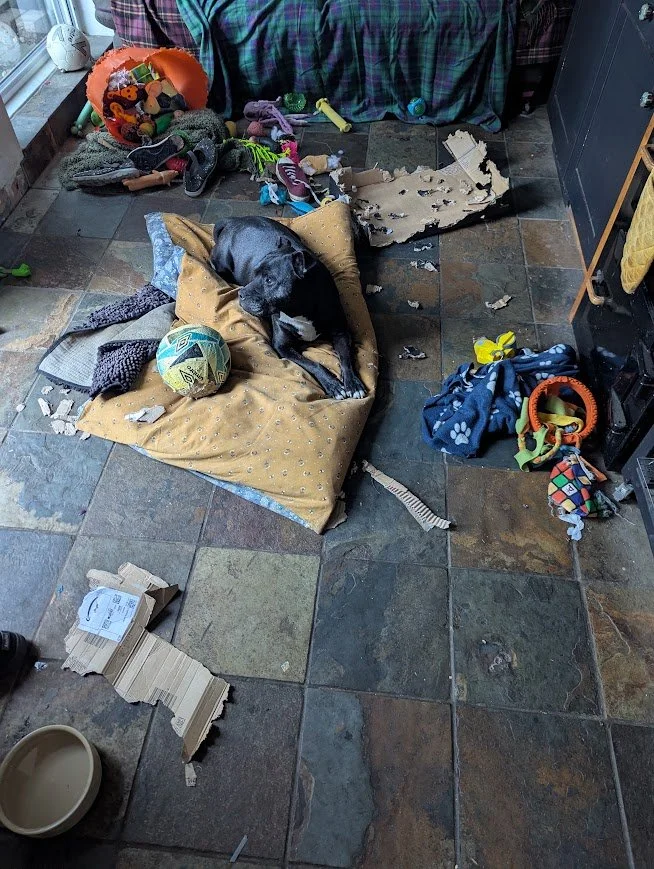
Silent but very messy intruders broke in and trashed the kitchen and threw all the toys around then ran away. Charlie was nowhere near at the time.
See you end of August- fingers crossed for some rain, please!
Karen X
