April showers. And baths and tiles.
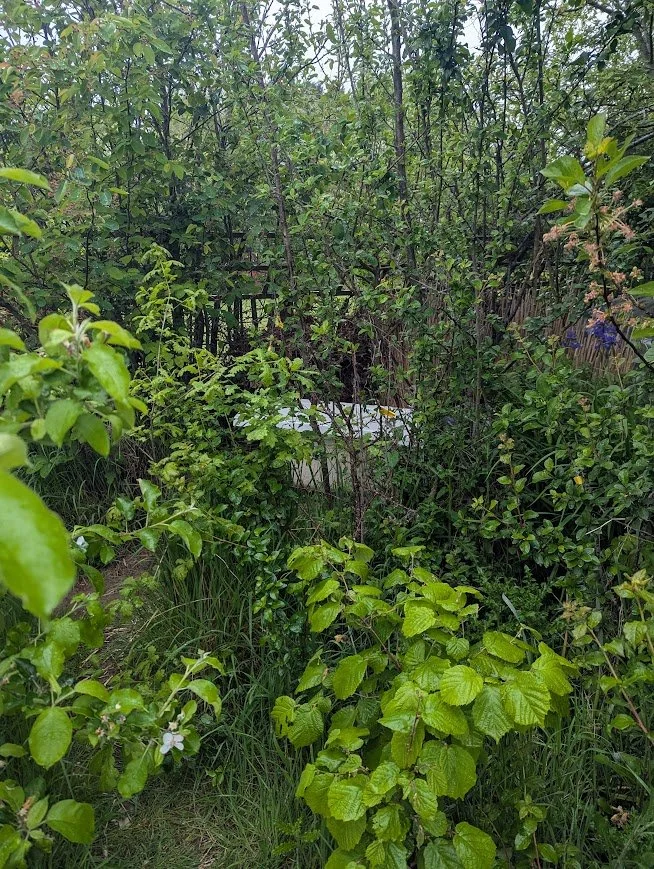
The old bath now lurks sinisterly in the undergrowth awaiting an upcycle into a wildlife pond.
We kicked the month of April off by getting our old bath replaced. A heavy and presumably cornered object had completely inexplicably dropped into it a couple of years ago, causing a slowly spreading and grimly discoloured crack.
In order for Greg (master of all trades) to do the job unmolested we booked Charlie into a boarding kennels. Charlie loves Greg, and wants to spend all his time with him, barking at him and trying to grab his power tools. Although this is very entertaining to watch it’s not much fun for Greg and not conducive to a precision plumbing job, so off Charlie went for a short holiday.
Apparently he was a credit to us and behaved very well, or so I was told by the kennels when we picked him up. He was a bit hoarse for a couple of days though- no doubt due to his 72 hour bark all you want binge.

Charlie with ears backswept by the sheer force of his barking
Now the new bath is in, and the old one is down the garden waiting to be turned into a wildlife pond. I’ve had to tile before Greg can come back and fit the shower and screen.
I like tiling; well in January I like tiling. When it’s maybe snowing and too inclement to venture out into the garden. In a lovely unseasonably warm and dry April when I want to be in my garden, I don’t like tiling nearly so much.
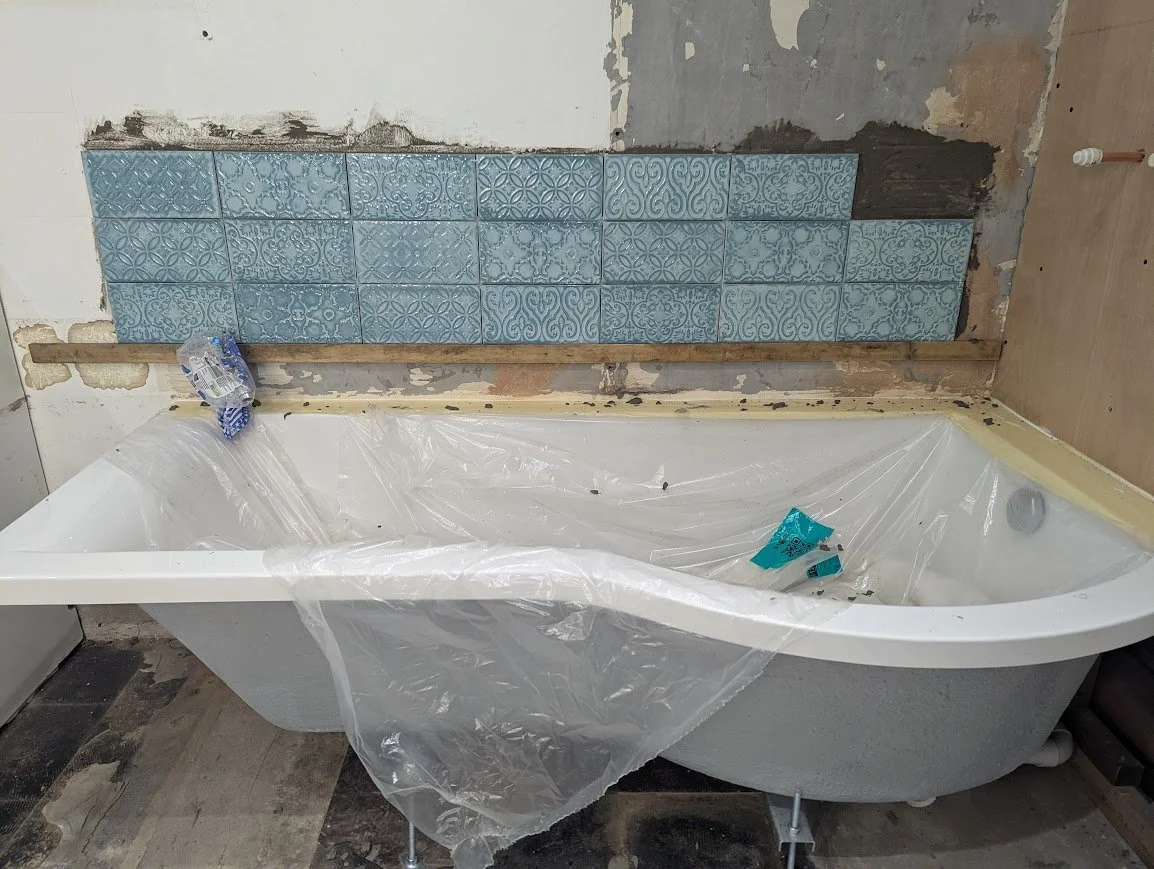
Early on in the tiling
So no showers for us in April, indoors or out, except for the one in the box in the garage waiting to be fitted. I wish the weather lady wouldn’t look so smug as she announces another ‘settled’ week of breezy dry weather. When I’ve not been tiling I’ve been watering the outdoor pots and the vegetable seeds.
The water butts have had a hose refill twice already . Watering by hose means dragging the thing around the garden, knocking over pots and crushing young plants. Then there’s the inevitable tug of war when Charlie gets interested. So in dry weather I fill my empty waterbutts with their connected dipping bins up all in one go and then water by can.
I have sown a couple of rows each of Carrots, parsnips, and beets direct into the veg beds. The first thing long root veg do is send down their tap root, and messing with that means a stubby forked harvest. The beets can be sown into modules but they don’t do well for me like that as I keep forgetting to water them.
I’ve also sown a row each of broad beans and peas in a weedy plot in a hiding in plain sight experiment. More on that next time.
More leafy greens and a huge number of potted up ornamentals and my wildflower and medicinal herb seedlings are in modules, ready to go out once the tiling is done. Well that’s my excuse anyway. I always end up with pots of plants everywhere in spring.
It’s been so bad that visiting gardener friends have claimed the sheer scale of my ready to plant out plant mountain made them feel a bit panicky. It always seems to work out okay in the end though.
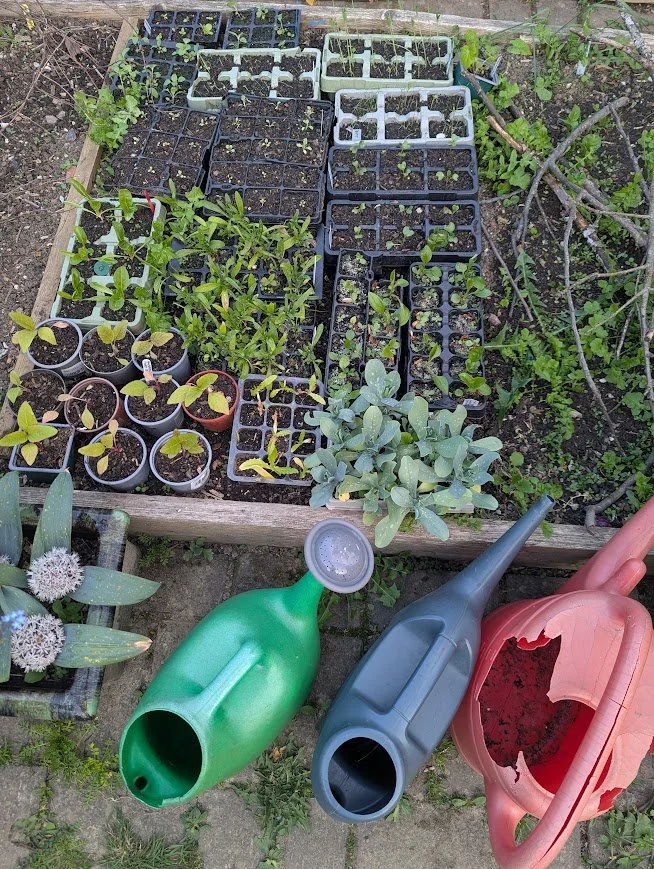
A few of the many trays and pots
The problem is the solution
When I was a girl our next door neighbour Mrs Palmer had a superb lavender hedge at the bottom of her garden that I used to creep through the fence to lay under. It was an amazing immersive sensory experience heat, intense lavender scent, dry grass pricking my back, bees buzzing all around.
At the bottom of our garden we had 2 rows of raspberries in a delicious but utilitarian triumph of working class practicality over posh garden frippery. Not at all as nice to lay under though.
I’ve tried to grow lavender many times since in an effort to recapture those elusive moments. I’ve failed miserably because I don’t live on alkaline chalky sandstone anymore. The soil in my garden is mildly acidic silt- clay loam.
Free draining? In my dreams! It’s heavy, it’s waterlogged in winter, it makes rude squelching sounds if you dare to walk on it. It sticks aggressively to your boots (if, that is, you are lucky enough to be able to wrest your boots from the morass and keep them on your feet). And it has that almost magical quality of being able to change consistency from custard to concrete within days when the rain stops.
However, a problem in the garden may be the solution (a Bill Mollison permaculture principle).
I did say to Greg when he put the deck in that I didn’t want it sided. Then I changed my mind but he was already busy with other jobs. In the interim a lovely idea emerged; to reduce the width of the path by the deck and plant a narrow scented dry bed in the poor soil under it. If I was lucky some of the old bricks may even have leached some lime into to soil to make it alkaline.
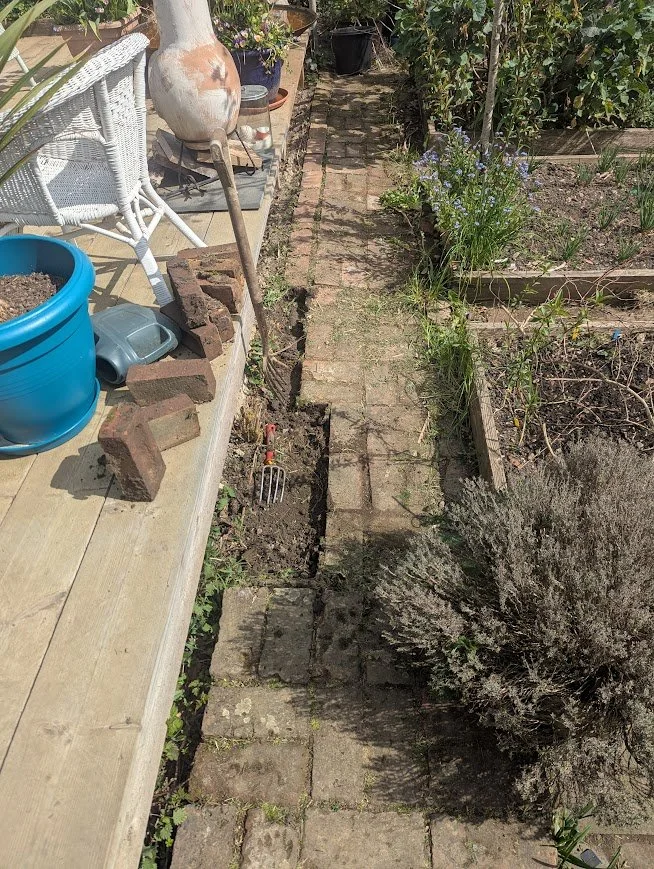
how to turn a path into a bed
The plants will grow up and hide the edge of the deck. If everything goes to plan I may be able to sit on my deck edge and relive those lavender memories.
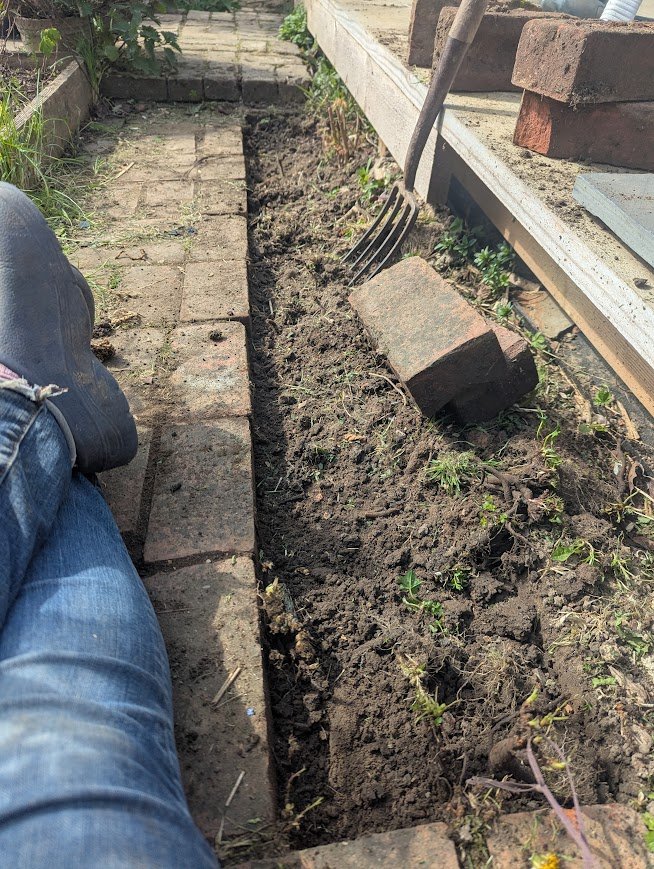
Pause for a cuppa
So far I have planted three small Lavender angustifolia (English lavender) some salvias and also colour from some alpines, and I’ll be adding to the planting as time goes on, maybe some bulbs. Aggies and even nerines may be able to survive in the sharp drainage and protected position.
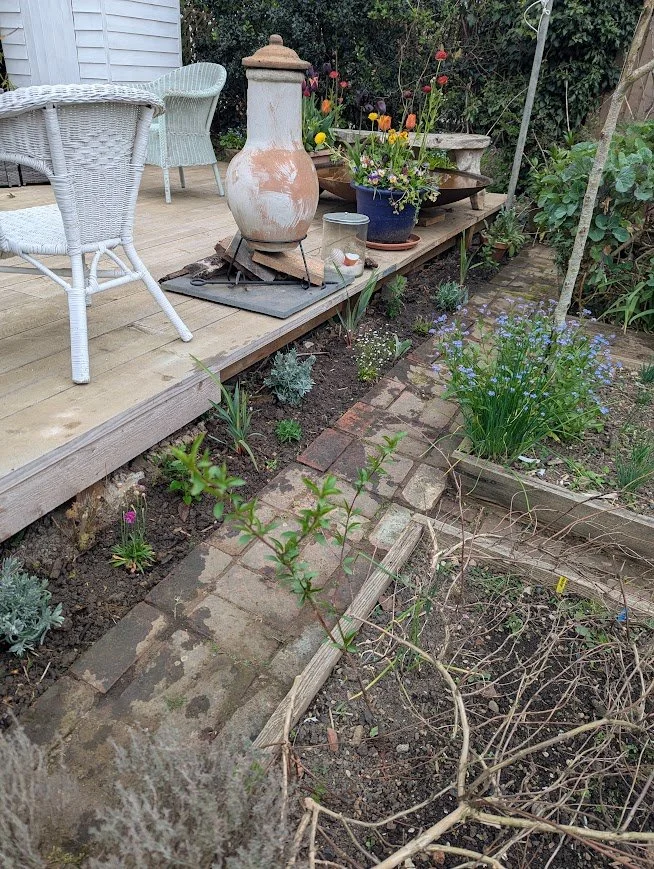
First plants are in
By the way, do you know the 8 8 8 rule for keeping lavender in shape? Lavender inevitably gets old and woody, but if you have a young plant, to prolong it’s vigour prune it back hard every year after flowering to 8” tall, 8” wide, in August. Don’t try this with big burley old plants, though, they’ll probably die!
April adventures in fermentation- Lilac wine
Lilac wine
Is sweet and heady,
Like my love
Lilac Wine, by James Shelton, sung by Elkie Brooks 1978
I was stripping lilac blossoms to make wine mid-month, sitting with my love at the patio table on a breezy yet warm afternoon. Our old lilac trees have flowered beautifully this year and we were drenched in the beautiful scent as we sat.
He was doing the crossword, and telling me about Elkie Brooks, and I was picking the aromatic little flowers from their bitter stalks, trying to take the sweet little nectaries with the flowers as I did so.
We mulled over ‘Desert Apple (6 letters)’. Whilst plucking I wondered idly if it was Datura (aka the Desert Thorn Apple) but it didn’t seem likely. Turns out the answer was Pippin. Dyslexia strikes again.
I’ve been meaning to try lilac wine for a couple of years and just got round to it. I found a recipe online, and this is my version.
Lilac Wine
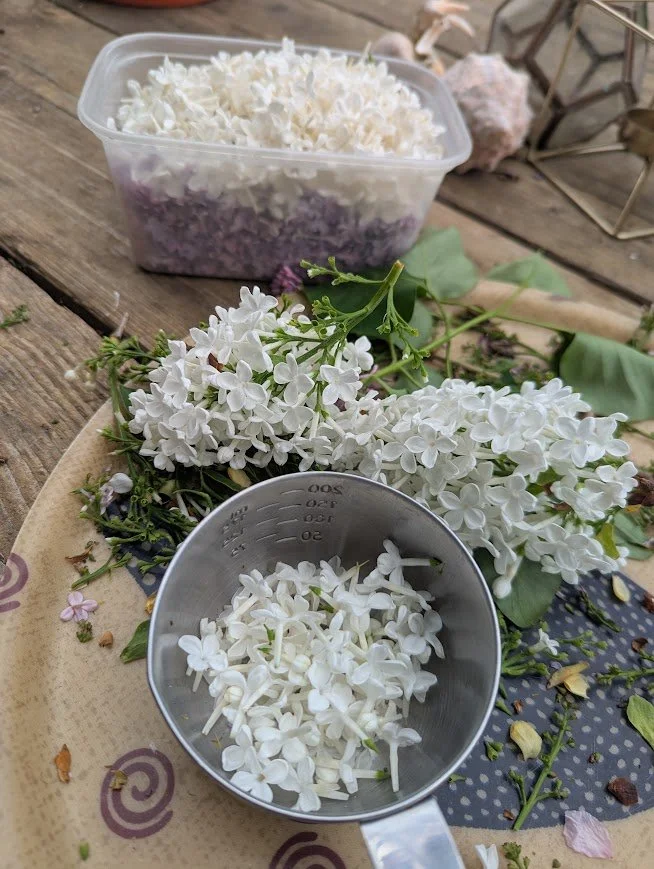
White lilac blossoms
Ingredients
6 cups of carefully plucked lilac flowers lightly packed. Apparently white flowers are lighter and brighter in taste, and purple are earthier, White are also larger, sturdier and easier to prepare.
6 cups of sugar
I cup of strong tea (for tannin)
1sachet yeast (my go to is the champagne yeast Lalvin EC-1118)
3 large lemons worth of juice
1tsp of yeast nutrient
1tsp Pectolase
1 Campden tablet
4.5L {1 gallon) water
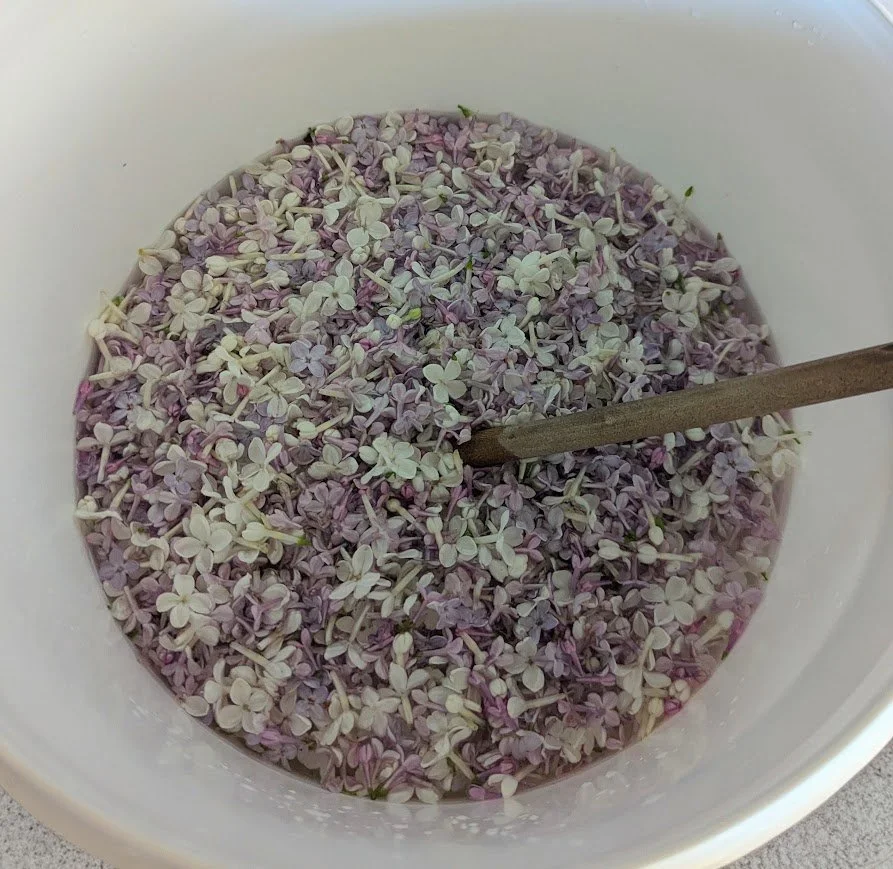
In the fermenting bucket and ready to go!
Method
Pluck the lilac flowers from their stalks, try to keep the nectaries with the flowers (you can tell if you don’t manage this as little thread like structures will be left behind poking out of the stalks).
Heat about 1.5L of the water with the sugar and bring to a simmer to completely dissolve it. Add to the rest of the water in a brew bucket then add the lilac blossom. Add the cooled cup of tea, the pectolase, and the juice of the lemons. Add a crushed campden tab and stir well, cover and leave for 24 hours.
Take an SG reading so you can calculate what your end ABV% should be.
Add yeast nutrient and pitch the yeast.
Put on an air lock and leave for 7-10 days in primary fermentation. Once activity has died down siphon to a demijohn leaving the flowers and continue to 2ndary fermentation.
Rack as necessary and mature 6-9 months before taking a final SG and bottling.
Broody Bird
Spring check list: Daffodils? Check, lawn needing a mow? Check, Robina and Robin Ruddock mounting a squatting offensive on the shed? Check.. Broody Hen? Sigh, Check!
Brahma Pootra is broody, as usual. Being broody for a chicken is a hormonal combination of severe baby longing and the worst PMT ever. She is fluffed up, bare bellied (having shed the feathers of her undercarriage so it’s nice and warm for the eggs), sulky, and extremely irritable. She just wants to sit on eggs. Anyone’s eggs in fact. Including the infertile eggs of birds not even the same species as her.
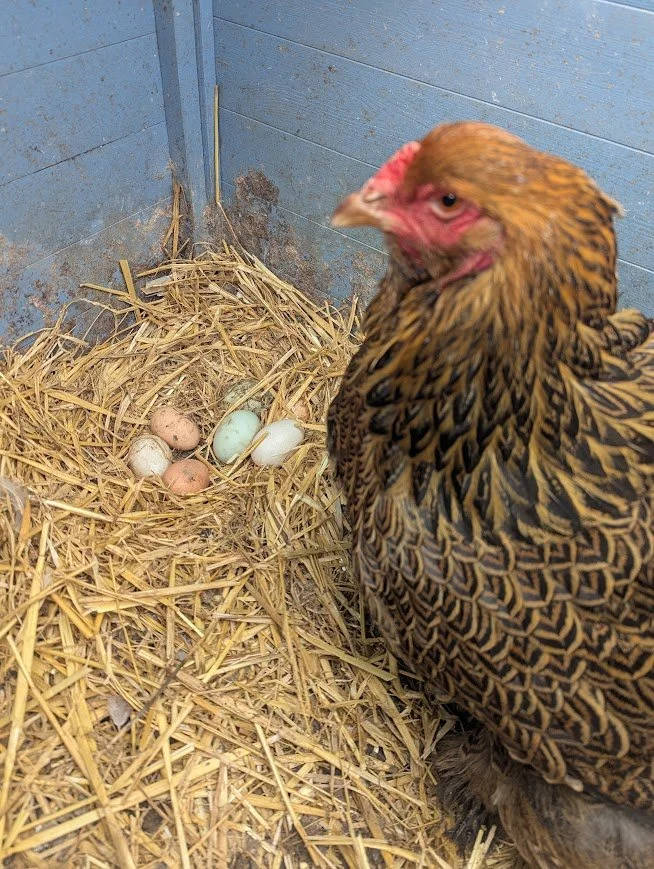
Pootra caught red handed with a selection of mixed species eggs- dirty hussy!
I remember my granddad (of greenhouse fame) telling me about broodies. To him, as a butcher, a proper chicken keeper (who didn't keep them as egg laying pets and was a bit squeamish about the dispatching, but used them for meat both for the family and to sell), and a Greatest Generation survivor of WW2, a broody was a valuable resource, not to be wasted.
He said (a few times because by then he was getting a little bit forgetful)- Put her in a wooden box, with some damp earth in the bottom and a layer of straw on top, and cover it over with a sack. If you have some china eggs put them under her (fake eggs for broodies are actually a thing you still get). Then you can get some fertile eggs for her to hatch. I also remember my dad telling me he was discouraged for giving his favourite hens names…
I know Pootra can’t help it. Chickens have a truly tiny brain to body ratio even for a bird, and aren’t the brightest penny in the purse at the best of times, so give them a dose of hormones and they’re well away to LaLa land.
But it’s irritating to have to turf her out of the duck house every morning and carry her down to the bottom run. I then give her hot little bare belly a quick dunk in the water bucket to cool her off, a time honoured method. I then have to block up the alleyway between the runs so she has to stay down with everyone else during the day and doesn’t sneak back up to sit on her non-existent eggs.
Hopefully she’ll snap out of it soon, because unlike granddad I like my hens with names and don’t tend to eat the difficult ones for Sunday lunch, causing lasting trauma to my children.
Broody chickens left to their own devices can lose condition quickly, they don’t eat and drink well or move around, and all this means they’re more vulnerable to any illness that comes along.
So I don’t let her near anywhere that could pass as a nest during the day. This means no-one else gets to lay anywhere that looks like a nest either so their eggs are here there and everywhere.
I’m hoping she’ll be over it in another couple of weeks, then Shanghai Brahma will take over. Last year once I’d broken Shanghai’s broodiness Pootra had a second go and they carried on alternating all summer.
Of all the chickens I’ve had, it seems to be the fluffy ones that are the worst for broodiness. Orpingtons are always very hormonal, and we once had a Pekin Bantam called Amy Fluffball that was so bad we eventually gave her back to my friend Gill who bred her. She used her for incubating orphan eggs on her smallholding, and she once sat and successfully hatched 21 at once! (Amy that is, not Gill).
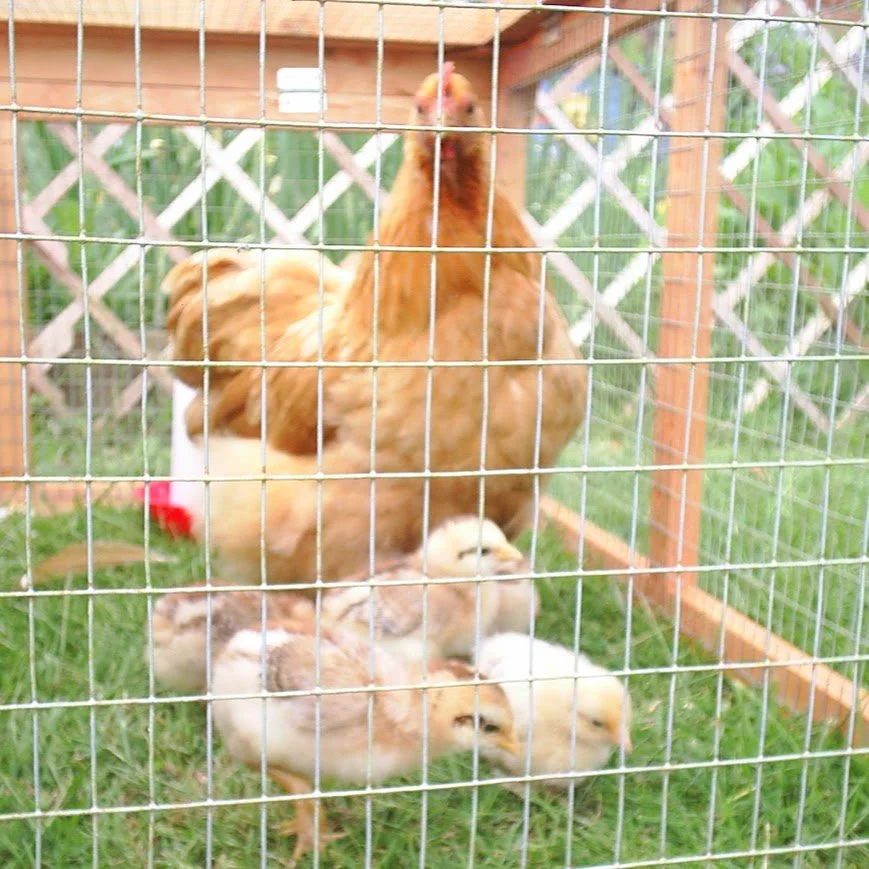
Amy and a brood of Marsh Daisy chicks, eggs from Gill
But these Brahmas take the broody prize. I’ve always loved the size and majesty of Brahmas and couldn’t resist getting them when the chance came. Never again though. Next time I get more hens it’ll be ex-bats rather than pimped up heavyweight hormonal American princesses.
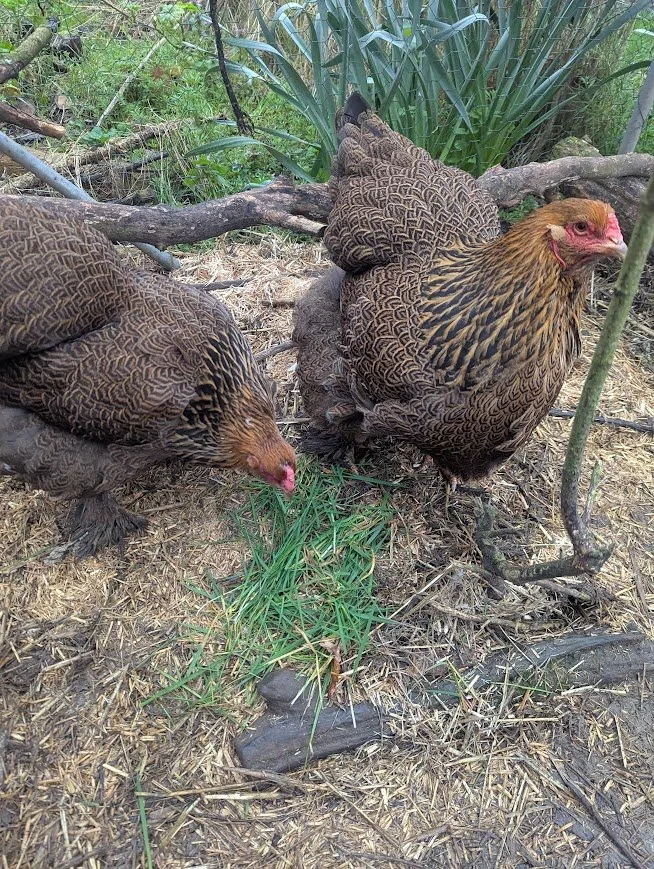
A pair of useless pure breed gold-laced partridge feathered Brahmas. A triumph of hormonal posh frippery over working class practicality. Mrs Palmer would no doubt love them. Granddad would never approve.
Want some seasonal tasks?
1. Keep watering and feeding tulips in pots, dead head by snipping the faded flower spikes just above the top leaf. Once the tops have died back dry the pot out and tip out the tulip bulbs. Store them in a cool dark place and plant them out in the garden (into long grass or under trees or shrubs) in November. They will flower for the next few years at least, smaller but still as beautiful, and some will clump up. I like this method because throwing away a perfectly good perennial bulb within months of buying it just feels wrong.
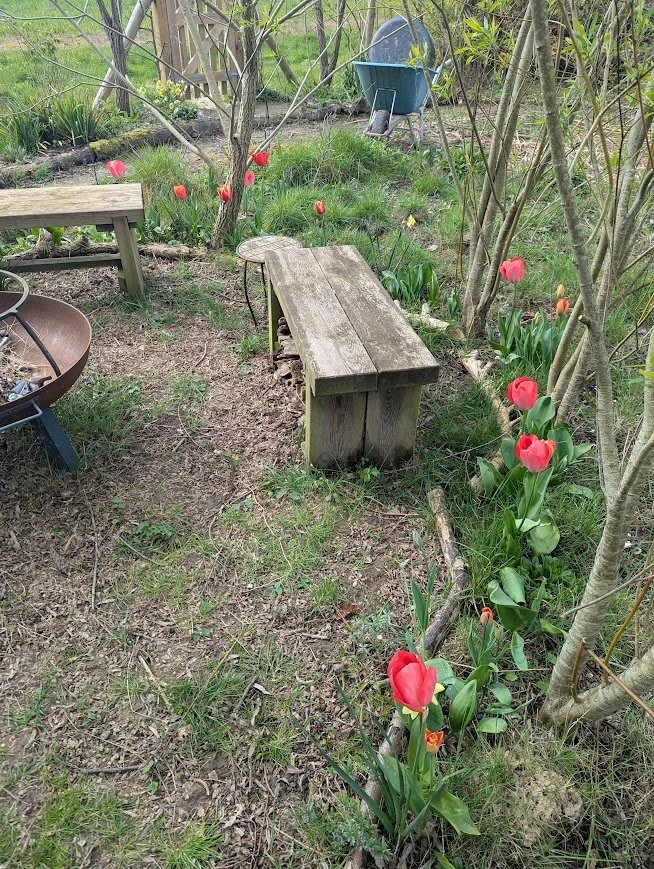
Second hand tulips around the fire pit living their best life and looking gorgeous
2. Take some pictures of your hostas now. You can look at these to console yourself when next month, whatever you do, the slugs and snails eat them into green doilies.
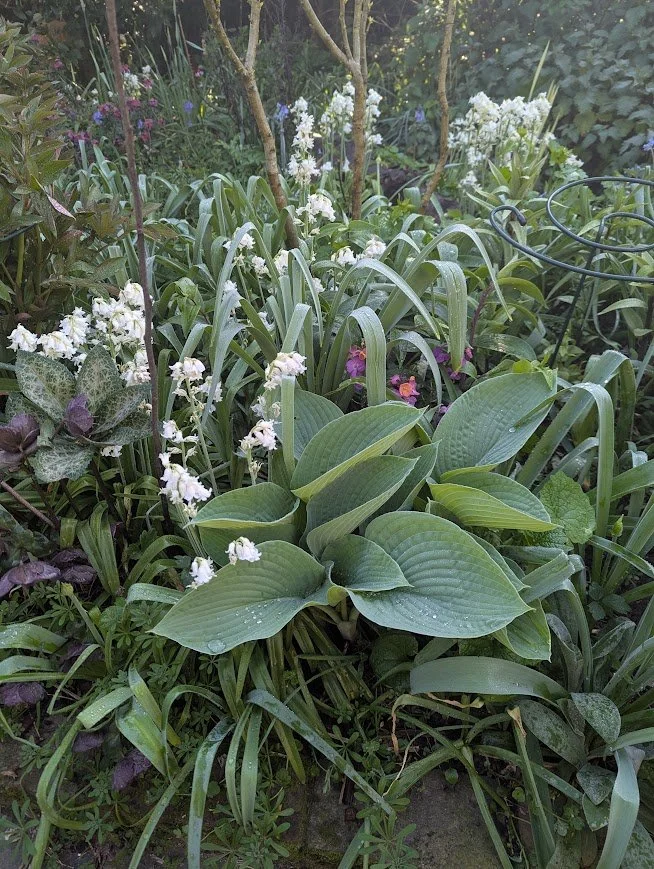
There’s a brief moment to enjoy hostas intact and it’s now
